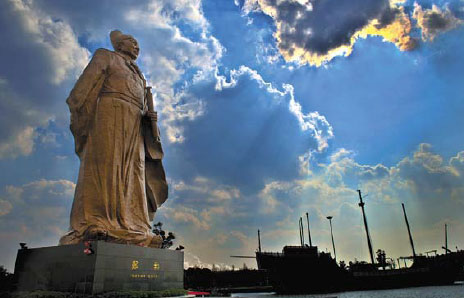
Zheng He
Introduction
Zheng He was a prominent Chinese navigator, explorer, and mariner during the early 15th century, renowned for his seven major expeditions to the Indian Ocean. He was born in 1371 in Jinning county, Kunming, in Yunnan province, China, and died in 1433. Zheng He led his voyages from 1405 to 1433. These expeditions expanded China's influence and facilitated trade across Asia and Africa.
Early Life and Rise
Zheng He, originally named Ma He, was born in the Yunnan province. Later he went to Nanjing, where he served in the household of the Prince of Yan (the future Yongle Emperor). Zheng He rose through the ranks due to his intelligence, loyalty, and bravery, eventually becoming a trusted military leader.
The Voyages
Between 1405 and 1433, Zheng He commanded seven voyages that extended China's maritime and diplomatic reach far beyond its borders. His fleet, featuring massive treasure ships, was an awe-inspiring sight to many of the places they visited. The voyages took him to more than 30 countries and regions, including parts of Southeast Asia, South Asia, the Middle East, and the east coast of Africa.
-
First Voyage (1405-1407): The fleet journeyed to Southeast Asia and the Indian subcontinent, reaching places like Java, Sumatra, and Ceylon.
-
Second Voyage (1407-1409): The expedition reinforced China's influence in Southeast Asia and reached Indian territories.
-
Third Voyage (1409-1411): Extended further to Hormuz in the Persian Gulf.
-
Fourth Voyage (1413-1415): Ventured to the Arabian Peninsula, including visiting Mecca, and the eastern coast of Africa.
-
Fifth Voyage (1417-1419): Strengthened trade and diplomatic relations with African and Middle Eastern states, reaching as far as the Red Sea.
-
Sixth Voyage (1421-1422): Continued efforts to establish Chinese presence and influence in the Indian Ocean.
-
Seventh Voyage (1431-1433): Zheng He's final voyage was the longest and traversed much of the previously visited regions, reinforcing Chinese authority and trade ties.
Legacy and Influence
Zheng He's expeditions significantly contributed to the Maritime Silk Road, facilitating cultural and economic exchanges between China and other civilizations. His voyages demonstrated China's naval capabilities and showcased its political power. Zheng He is celebrated for his role in establishing diplomatic relationships and trade partnerships across Asia and Africa.
The Zheng He Memorial Hall in Kunming, Yunnan province, commemorates his achievements and houses various historical materials and documents that highlight the significance of his voyages. His legacy continues to influence modern perceptions of Chinese maritime exploration and diplomacy.
Zheng He's voyages have been the subject of various cultural references and historical studies. His expeditions form a crucial chapter in Chinese maritime history, illustrating the Ming Dynasty's ambition to project power and influence across distant lands. Zheng He's journeys are often viewed as a demonstration of peaceful exchanges rather than military conquests, reflecting the Ming Dynasty's approach to foreign relations during his time.
Modern Commemorations and Interpretations
In recent years, Zheng He's life and expeditions have been celebrated and remembered through various cultural and educational initiatives, including documentaries and exhibitions. Projects like the documentary "Sunshine Road," produced in collaboration with international partners, seek to explore and share the historical significance of Zheng He's voyages and their impact on global maritime culture.
His expeditions are often compared to other great explorers and navigators, highlighting the grandeur and scope of his maritime achievements in the context of world history. Zheng He's legacy continues to inspire interest in historical navigation, trade, and the cultural interactions that shaped the early modern world.








